

Free 2026 JN0-364 Dumps 100 Pass Guarantee With Latest Demo
Prepare JN0-364 Question Answers Free Update With 100% Exam Passing Guarantee [2026]
NEW QUESTION # 22
A service provider is onboarding a new enterprise customer that operates multiple branch offices, each with its own set of VLANs. The customer requires transparent Layer 2 connectivity between sites while maintaining separation of internal VLANs. The provider must also ensure that customer VLAN identifiers do not conflict with other customers on the shared infrastructure. Which solution would provide the desired results?
- A. Extend customer VLANs using Q-in-Q tunneling.
- B. Deliver Layer 3 VPN services using MPLS.
- C. Aggregate customer traffic using GRE tunnels.
- D. Provide Internet access with NAT and firewall services.
Answer: A
Explanation:
In a service provider environment,Q-in-Q tunneling(also known as 802.1ad or double-tagging) is the standard solution for transporting multiple customer VLANs over a shared provider backbone while maintaining total separation.
According to Juniper Networks documentation, Q-in-Q works by adding a second 802.1Q tag (theService Provider tagor S-tag) to the customer's already tagged frames (theCustomer tagor C-tag). This creates a
"tunnel" at Layer 2. This solution specifically addresses all the customer's requirements:
* Transparent Layer 2 Connectivity:Because the provider simply encapsulates the customer's frames, the customer's internal BPDU traffic (like Spanning Tree) and VLAN tags are preserved and delivered transparently to the remote site.
* Separation of Internal VLANs:The customer can run their own internal VLAN IDs (1-4094) without the provider needing to know or manage them.
* Conflict Avoidance:Different customers on the same provider infrastructure are assigned unique S- tags. Even if two different customers both use "VLAN 10" internally, they remain isolated because their traffic is encapsulated in different provider S-tags.
Why other options are incorrect:
* Layer 3 VPN (Option B):While MPLS L3VPNs are common, they provide Layer 3 (IP) connectivity, not the "transparent Layer 2" connectivity requested.
* GRE Tunnels (Option C):GRE is a Layer 3 encapsulation and does not natively provide the transparent VLAN bridging required for a multi-site Layer 2 service.
* NAT/Firewall (Option D):These are security and address-translation services for internet access and do not facilitate site-to-site Layer 2 bridging.
NEW QUESTION # 23
You are asked to add next-hop redundancy using VRRP for an IPv6 enabled service. The configured primary router must always be active when available, and the servers connected to the network must be able to ping their gateway. Which VRRP element is required to accomplish this requirement?
- A. Both routers running VRRP will require a static ARP entry to be configured for the VRRP VIP.
- B. The backup router requires the track parameter to track the primary router's interface.
- C. The preempt parameter must be added to the VRRP configuration.
- D. The accept-data parameter must be added to the VRRP configuration.
Answer: D
Explanation:
InVirtual Router Redundancy Protocol (VRRP), the primary goal is to provide a highly available default gateway for end hosts. However, there is a specific operational behavior in the VRRP standard (RFC 3768
/RFC 5798) regarding how the "Virtual Router" responds to traffic destined for its own Virtual IP (VIP).
According to Juniper Networks documentation, by default, a VRRP router that is in the Master state will only respond to packets destined for the VIP if that router is theIP Address Owner(meaning its physical interface IP matches the VIP). If the router is a "non-owner" (a common configuration in many networks), it will forward traffic on behalf of the VIP but will not respond to management traffic, such asICMP Echo Requests (Pings), directed at the VIP itself.
To satisfy the requirement that "servers connected to the network must be able to ping their gateway," the accept-data (Option D)parameter must be configured. In Junos OS, the accept-data statement allows the VRRP Master to respond to traffic destined for the virtual IP address even if it is not the address owner. This includes responding to Pings and allowing other management connections like SSH or Telnet to the VIP.
Regarding the other options:
* Preempt (Option B):While preempt is often used to ensure the primary router regains control, in Junos, a router with the highest priority (255) defaults to preemptive behavior, and accept-data is specifically what solves the "pinging the gateway" requirement.
* Track (Option A):Tracking is used for failover logic but doesn't affect the ability to ping the VIP.
* Static ARP (Option C):This is unnecessary as VRRP uses a virtual MAC address to ensure hosts can resolve the VIP via standard NDP (for IPv6) or ARP (for IPv4).
NEW QUESTION # 24
A BGP router receives two routes to the same prefix. One route has a higher local preference, while the other has a shorter AS path. In this scenario, which route would be selected?
- A. The route with the lowest MED value.
- B. The route with the higher local preference.
- C. The route with the lower origin code.
- D. The route with the shorter AS path.
Answer: B
Explanation:
TheBGP path selection algorithmis a deterministic process used by Juniper routers to select the single "best" path from the BGP table to be placed into the routing table (inet.0). This algorithm follows a specific, hierarchical set of rules. According to Juniper Networks technical documentation, the router evaluates attributes in a fixed order, and once a tie is broken at a specific step, the remaining steps are ignored.
The order of the primary BGP attributes in Junos OS is as follows:
* Highest Local Preference:This is the first attribute evaluated after the basic check for a reachable next hop. Local preference is used within an Autonomous System (AS) to prioritize one exit point over another.
* Shortest AS_PATH:If the local preference is equal, the router then evaluates the length of the AS_PATH attribute.
* Lowest Origin Code:(IGP < EGP < Incomplete).
* Lowest Multi-Exit Discriminator (MED).
In this specific scenario, the router compares a path with ahigher local preferenceagainst a path with a shorter AS path. Because theLocal Preferencecheck occurs at Step 1 and theAS_PATHcheck occurs later at Step 2, the router will select the path with the higher local preference immediately. The length of the AS path becomes irrelevant in this comparison because the tie was already broken by the local preference value.
This allows network administrators to override the default "shortest path" logic of BGP to prefer specific providers or links based on business requirements.
NEW QUESTION # 25
For two or more switches to participate in the same MSTP region, which parameter must match?
- A. Region name
- B. Extended system ID
- C. Root bridge priority
- D. Root bridge ID
Answer: A
Explanation:
Multiple Spanning Tree Protocol (MSTP), as defined in IEEE 802.1s and implemented in Juniper Networks Junos OS, allows for the grouping of VLANs into specific spanning tree instances. This provides significant scalability and load-balancing advantages over traditional STP or RSTP. To achieve this, switches must be grouped into logical "Regions." According to Juniper documentation, for two or more switches to be considered part of the sameMSTP Region, they must possess an identicalMSTP Configuration Identifier. This identifier consists of three specific attributes that must match exactly across all participating switches:
* MSTI Name (Region Name):A descriptive string (up to 32 characters) that identifies the region.
* MSTI Revision Level:A numerical value (0-65535) used to track configuration changes.
* VLAN-to-Instance Mapping:The specific table that defines which VLAN IDs are associated with which Multiple Spanning Tree Instances (MSTIs).
If even one of these parameters-such as theRegion name(Option A)-differs, the switches will treat each other as being in separate regions. When switches are in different regions, they interact using theCommon Spanning Tree (CST), effectively seeing the other region as a single "virtual bridge," which limits the granularity of traffic engineering.
TheExtended system ID(Option B) is a component of the Bridge ID used to carry VLAN information in PVST+ but is not a region-matching requirement.Root bridge priority(Option C) andRoot bridge ID(Option D) are variables used during the STP election process to determine the topology's root, but they do not define the boundaries of an MSTP region itself.
NEW QUESTION # 26
Which IPv6 extension header is used to specify intermediate nodes for a packet's path?
- A. fragment
- B. destination options
- C. routing
- D. hop-by-hop options
Answer: C
Explanation:
In the IPv6 architecture, the base header is kept at a fixed size of 40 bytes to streamline processing. Any additional features or options are handled byExtension Headers, which are inserted between the IPv6 header and the upper-layer protocol. According to Juniper Networks technical documentation and RFC 8200, when a source node needs to list one or more intermediate nodes to be "visited" on the way to the final destination, it utilizes theRouting extension header (Option B).
The Routing header is functionally similar to the "Source Route" option in IPv4. When a packet contains a Routing header, it is addressed to the first intermediate node listed in the header. That node examines the header, swaps its own address with the next address in the list, and forwards the packet. This process continues until the packet reaches the final destination. This is a foundational component for technologies like Segment Routing over IPv6 (SRv6), where the Routing header (specifically the Segment Routing Header or SRH) is used to steer traffic through a specific set of service instructions or nodes.
To distinguish this from the other options:
* Hop-by-hop options (Option A):These carry information that must be examined byeverynode along the path (such as Router Alert), not just specific intermediate nodes.
* Fragment (Option C):This is used only when the source node needs to fragment a packet that exceeds the path MTU.
* Destination options (Option D):These carry optional information intended specifically for the destination node (or nodes listed in a Routing header), but they do not dictate the path themselves.
NEW QUESTION # 27
You are the administrator for two Junos routers called R1 and R2. These two routers are directly connected to each other. These two routers run IS-IS and BFD. R1 is configured to send BFD packets every 300 milliseconds. R2 is configured to send BFD packets every 400 milliseconds. In this situation, what is the expected outcome?
- A. Each router will negotiate to send BFD packets at the slowest of the two rates.
- B. BFD will fail due to the mismatched timers.
- C. Each router will negotiate to send BFD packets at the fastest of the two rates.
- D. Each router will send BFD packets at the rate that has been locally configured.
Answer: A
Explanation:
In the context of Juniper Networks High Availability,Bidirectional Forwarding Detection (BFD)is a lightweight protocol designed to provide fast failure detection for the forwarding path. Unlike the slow "hello" mechanisms found in IGPs like OSPF or IS-IS, BFD can detect link or neighbor failures in sub-second intervals.
According to Juniper Networks technical documentation, BFD operates through a negotiation process. When two routers establish a BFD session, they exchange their locally configuredMinimum Transmit Intervaland Minimum Receive Intervalwithin the BFD control packets. The fundamental rule of BFD negotiation is that the routers must agree on a common timing value that accommodates the slower of the two devices to ensure stability and prevent "false positives" (detecting a failure when none exists simply because one router cannot keep up with the processing speed).
In this scenario, R1 expects to send at 300ms, while R2 is configured for 400ms. During the handshake, R1 informs R2 it is capable of 300ms, but R2 informs R1 it can only support a minimum of 400ms.
Consequently, the routers will negotiate to use theslowest of the two rates (400ms). Specifically, the transmission interval of one router is matched to the receive interval of the other. By choosing the highest common denominator (the slowest rate), the BFD session ensures that both routers have sufficient time to process incoming control packets. This negotiation allows BFD to be highly flexible in heterogeneous environments where different hardware platforms may have varying CPU capabilities for handling rapid heartbeat packets.
NEW QUESTION # 28
Which BGP attribute is optional, transitive, and is passed unchanged to other BGP peers if not recognized?
- A. Community
- B. Origin
- C. AS Path
- D. MED
Answer: A
Explanation:
BGP attributes are categorized into four distinct types based on how they are handled by a BGP speaker:Well- known mandatory,Well-known discretionary,Optional transitive, andOptional non-transitive.
Understanding these categories is essential for traffic engineering and ensuring consistent policy across an Autonomous System.
According to Juniper Networks technical documentation, theCommunityattribute is classified as anoptional transitiveattribute. The term "optional" implies that a BGP implementation is not required to support or recognize the attribute. However, because it is "transitive," if a Juniper router receives an update containing a community tag that it does not recognize or has no specific policy for, it must accept the attribute and pass it along to other BGP peers unchanged. This ensures that community-based policies can be signaled across intermediate ASes that may not be configured to act upon those specific tags.
In contrast:
* Origin (Option A)andAS Path (Option B)arewell-known mandatoryattributes. Every BGP update must include these, and every BGP-compliant router must recognize them.
* MED (Option D)(Multi-Exit Discriminator) is anoptional non-transitiveattribute. If a router receives a MED and advertises that route to an EBGP peer, the MED is typically stripped away (unless specific configurations like path-selection cisco-non-deterministic are used), as it is intended only to influence the immediate neighboring AS.
The Community attribute (defined in RFC 1997) is a powerful tool in Junos OS, often used for tagging routes to trigger specific routing policies, such as setting local preference or identifying the geographic origin of a prefix. By being transitive, it allows for sophisticated administrative control across complex multi-provider environments.
NEW QUESTION # 29
What are two types of BGP messages exchanged while in the Established state? (Choose two.)
- A. open
- B. notification
- C. update
- D. request
Answer: B,C
Explanation:
In theBorder Gateway Protocol (BGP)finite state machine (FSM), theEstablishedstate is the final and functional stage of a BGP peering session. According to Juniper Networks technical documentation, once a session reaches this state, the two peers have successfully exchanged Open messages and agreed upon session parameters (such as AS numbers, hold timers, and BGP identifiers). Only after the session is "Established" can the routers begin the actual exchange of network layer reachability information (NLRI).
The most frequent message type exchanged in the Established state is theUPDATEmessage. These messages are the heart of BGP operations; they are used to advertise new feasible routes to a peer or to withdraw routes that are no longer reachable. An UPDATE message contains path attributes (like AS-Path, Next-Hop, and Local Preference) and the associated prefixes. In a stable network, UPDATE messages are only sent when there is a change in the topology, adhering to BGP's incremental update philosophy.
The second message type that can be exchanged in this state is theNOTIFICATIONmessage. While ideally, a session stays established, any detected error-such as a hold timer expiration, a malformed update, or a manual "clear" command-will trigger the transmission of a NOTIFICATION message. This message informs the peer of the specific error code and immediately causes the BGP session to transition back to the Idle state, tearing down the TCP connection.
It is important to note thatOPENmessages (Option A) are only used during the session initialization phase to transition from the OpenConfirm state to Established.REQUEST(Option B) is not a valid BGP message type defined in the standard (RFC 4271); the closest equivalent in functionality would be a Route-Refresh message, which is a separate extension. Therefore, in the context of standard BGP operations within the Established state, Updates and Notifications are the correct answers.
NEW QUESTION # 30
You are asked to configure a new network environment that will be based on IPv6 and use OSPF. In this scenario, which two statements correctly identify configuration task considerations? (Choose two.)
- A. The router ID used must be based on a 32-bit identifier value.
- B. Participating interfaces are only required to be configured with the IPv6 protocol family and address.
- C. The router ID used must be based on a 128-bit identifier value.
- D. Participating interfaces must be configured with both IPv4 and IPv6 protocol families and addresses.
Answer: A,B
Explanation:
When transitioning to an IPv6 environment usingOSPFv3(the version of OSPF designed for IPv6), there are significant architectural differences compared to OSPFv2 (IPv4). According to Juniper Networks technical documentation, OSPFv3 was redesigned to be more protocol-agnostic.
Router ID (Option C):
Despite OSPFv3 routing IPv6 (which uses 128-bit addresses), the OSPFRouter IDremains a32-bit value formatted like an IPv4 address (e.g., 1.1.1.1). This is a common point of confusion. In a pure IPv6 environment where no IPv4 addresses are configured on any interfaces, a Juniper router cannot automatically derive a Router ID. Therefore, the administrator must manually configure a 32-bit Router ID under [edit routing-options] for the OSPFv3 process to initialize.
Interface Configuration (Option D):
OSPFv3 runs directly over the IPv6 link-local scope. Unlike OSPFv2, it does not require an IPv4 address to function. Therefore, interfaces areonly required to be configured with family inet6(Option D). You do not need "dual-stack" (both IPv4 and IPv6) functionality just to run OSPFv3. The protocol uses the link-local address (fe80::/10) of the interface for neighbor adjacencies and as the next hop for routing updates. This separation allows OSPFv3 to carry multiple "address families" (both IPv4 and IPv6 unicast) if needed, but the base requirement for an IPv6-only network is simply the family inet6 configuration.
NEW QUESTION # 31
Exhibit: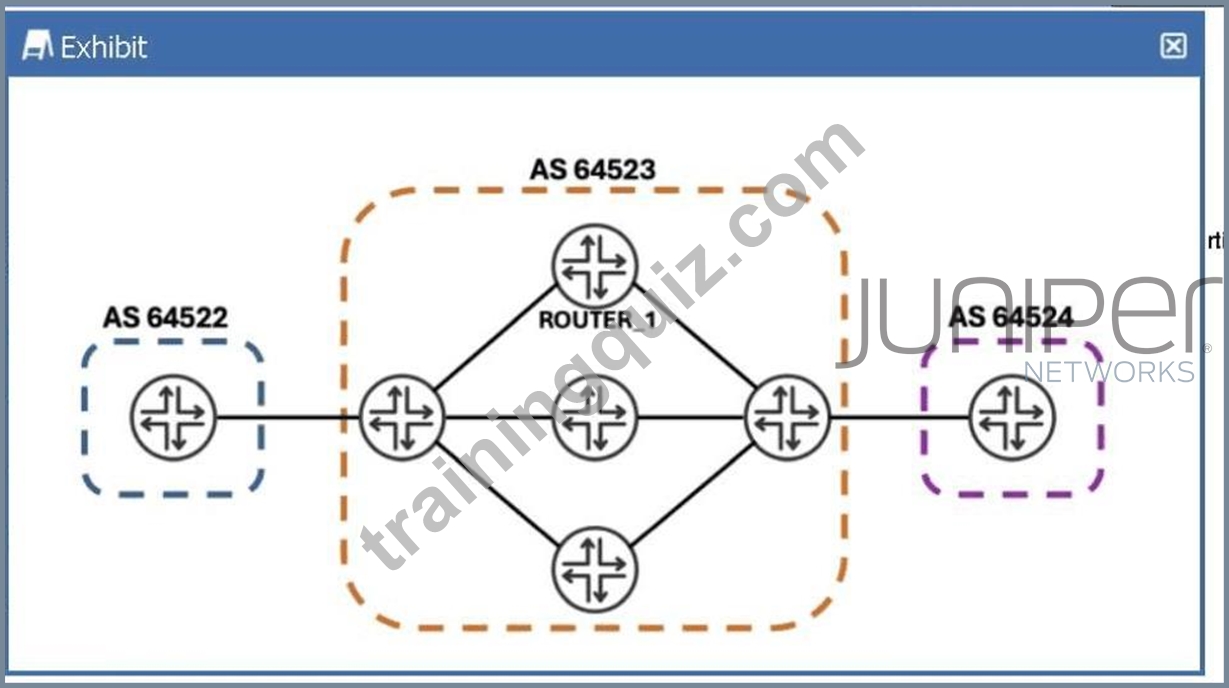
You must configure the router called ROUTER_1 to take all valid prefixes learned from internal BGP peers in AS 64523, and then re-advertise them to other internal BGP peers in the same autonomous system.
Referring to the exhibit, which configuration must you deploy on ROUTER_1 to accomplish this task?
- A. Configure ROUTER_1's internal BGP group with the keyword cluster, followed by a unique 32-bit number.
- B. Configure ROUTER_1 to belong to a different autonomous system than the other BGP routers in your network.
- C. Configure a routing policy on ROUTER_1 that removes the no-export BGP community from all received prefixes.
- D. Configure ROUTER_1's internal BGP group with a routing policy that exports prefixes learned from internal BGP.
Answer: A
Explanation:
In theBorder Gateway Protocol (BGP), theSplit Horizonrule is a fundamental loop-prevention mechanism for internal sessions. This rule dictates that a BGP speaker must not advertise a route learned from anInternal BGP (IBGP)peer to any other IBGP peer within the same Autonomous System (AS). This ensures that routes do not circulate infinitely inside a network, as IBGP does not modify the AS_PATH attribute. Consequently, to maintain full reachability, a network normally requires a "full mesh" of IBGP sessions, where every BGP- speaking router is directly peered with every other router.
In the provided exhibit,ROUTER_1is part of AS 64523. The requirement is for ROUTER_1 to take prefixes learned from its internal peers and re-advertise them to other internal peers in the same AS. This behavior is a direct violation of the standard Split Horizon rule. According to Juniper Networks technical documentation, the standard solution to scale IBGP without a full mesh is to configureRoute Reflection.
When a router is configured as aRoute Reflector (RR), it is permitted to "reflect" (re-advertise) routes learned from one IBGP peer to another. In Junos OS, the mechanism to enable Route Reflection is to configure acluster IDwithin the BGP group. By adding the cluster keyword followed by a unique 32-bit identifier (usually the router's loopback address) to the internal BGP group configuration, the router assumes the role of an RR. It then follows specific reflection rules:
* Routes learned from anEBGP peerare reflected to all IBGP peers.
* Routes learned from aRoute Reflector Clientare reflected to all other clients and non-clients.
* Routes learned from anon-clientare reflected to all clients.
Option A is incorrect because BGP advertisement rules are hard-coded; a standard export policy cannot override the Split Horizon rule. Option C handles traffic engineering tags but does not enable route reflection.
Option D would change the session to EBGP, which does not address the internal reachability requirement within AS 64523. Therefore, configuring the cluster ID is the only valid way to achieve the desired re- advertisement behavior.
NEW QUESTION # 32
What happens if an IS-IS router receives a link-state PDU with a higher sequence number than the one in its database?
- A. It ignores the link-state PDU.
- B. It resets the adjacency with the source of the link-state PDU.
- C. It sends a CSNP to request confirmation from the source of the link-state PDU.
- D. It updates its database and floods the link-state PDU.
Answer: D
Explanation:
IS-IS is a link-state protocol that relies on the rapid and consistent flooding ofLink-State PDUs (LSPs)to ensure that every router in an area has an identical view of the topology. To manage the "freshness" of information, IS-IS uses aSequence Number-a 32-bit unsigned integer that increments every time the originating router makes a change to its LSP.
According to Juniper Networks technical documentation, when a router receives an LSP, it performs a comparison between the received LSP and the version it currently holds in itsLink-State Database (LSDB).
If the received LSP has ahigher sequence number, the router concludes that this is "newer" and more accurate information. The router will then perform two immediate actions:
* Update:It replaces the older LSP in its LSDB with the newly received version.
* Flood:It propagates the new LSP to all other neighbors (except the one that sent it) to ensure the entire area converges on the new data.
If the sequence numbers were equal, the router would ignore the incoming PDU as it already has the information. If the received sequence number werelower, the router would conclude its own database is more recent and would actually send its own "newer" version back to the neighbor to bring them up to date (a process called "poisoning" or refreshing the neighbor).Complete Sequence Number PDUs (CSNPs)(Option C) are used during initial database synchronization or periodic checks on broadcast links, but the primary response to a "newer" LSP is immediate database update and flooding.
NEW QUESTION # 33
You are monitoring OSPF on a router and notice frequent state changes between Full and Down. Which condition would cause this behavior?
- A. MTU mismatch
- B. route preference mismatch
- C. physical interface flapping
- D. area ID mismatch
Answer: C
Explanation:
When troubleshooting OSPF in a service provider environment, distinguishing between "stuck" adjacencies and "flapping" adjacencies is the first step. A session that transitions frequently betweenFullandDown indicates that the relationship can be established successfully (meaning parameters match), but it cannot be maintained.
According to Juniper Networks documentation, the most common cause for a session to drop from Full to Down is the expiration of theDead Interval. If a router does not receive a Hello packet within the Dead Interval (usually 40 seconds), it tears down the adjacency. Aphysical interface flapping (Option A)is the primary trigger for this. If the physical link or the underlying transport (like a leased line or a microwave link) goes down even momentarily, the OSPF process immediately detects the interface failure, flushes the neighbors, and moves the state to Down. As soon as the interface comes back up, the routers perform the Hello exchange and reach the Full state again, creating the flapping cycle.
Analysis of other options:
* MTU Mismatch (Option D):This typically causes the adjacency to get "stuck" in theExchangeor ExStartstate. The routers can exchange small Hello packets, but when they try to send larger Database Description (DBD) packets that exceed the MTU, the packets are dropped, preventing the session from ever reaching "Full."
* Area ID Mismatch (Option C):This prevents the adjacency from even reaching theInitstate; the routers will never form a neighbor relationship.
* Route Preference (Option B):This affects which route is chosen for the forwarding table but has no impact on the OSPF neighbor state machine itself.
NEW QUESTION # 34
You are evaluating BGP between two Juniper routers and the BGP session is stuck in the Idle state. What would cause this behavior?
- A. The peer IP address is incorrect.
- B. The BGP group type is set to internal instead of external.
- C. The BGP hold time is too short.
- D. The local AS number is missing.
Answer: A
Explanation:
In the BGP Finite State Machine (FSM), theIdlestate is the first stage of any BGP connection. When a BGP session is "stuck" in Idle, it typically indicates that the router is unable to even begin the process of establishing a TCP connection with its neighbor. According to Juniper Networks documentation, before BGP can transition to theConnectorActivestates, it must have a valid route to the neighbor's IP address in the routing table and be able to initiate a three-way TCP handshake on port 179.
If thepeer IP address is incorrect(Option D), the router may not have a route to that destination, or it may be attempting to connect to a non-existent or unreachable host. In many Junos configurations, if the underlying IGP (OSPF/IS-IS) or static routing cannot provide reachability to the neighbor address defined in the BGP configuration, the BGP process will remain in the Idle state and periodically retry the connection.
Regarding the other options:
* The local AS number is missing (Option C):In Junos, you cannot commit a BGP configuration if the local autonomous system is not defined at either the [edit routing-options] level or within the BGP group itself. The commit check would fail before the session could even attempt to start.
* The BGP group type (Option B):Having a mismatch in group type (internal vs. external) usually results in the session reaching theOpenSentorOpenConfirmstate before failing due to an
"unacceptable AS" error in the OPEN message.
* BGP hold time (Option A):Issues with hold timers or keepalives generally cause a session that is already in theEstablishedstate to drop; they do not prevent the session from leaving the Idle state.
NEW QUESTION # 35
What information is determined by using the AS path attribute included in the BGP update message? (Choose two.)
- A. the shortest AS path to reach a prefix
- B. the presence of a routing loop
- C. the origin of a route from IGP or EGP
- D. the total number of next-hop devices to reach a prefix
Answer: A,B
Explanation:
TheAS_PATHattribute is a "well-known mandatory" attribute in BGP, meaning it must be present in every BGP Update message exchanged between External BGP (eBGP) peers. It records the sequence of Autonomous System numbers that a route has traversed. Per Juniper Networks Service Provider documentation, this attribute serves two fundamental purposes:
1. Loop Prevention (Option B):
This is the most critical function of the AS_PATH. When a BGP router receives an update from an eBGP peer, it scans the AS_PATH attribute for its own AS number. If the router finds its local AS number already listed in the path, it concludes that the route has already passed through its network and has "looped" back. To prevent an infinite routing loop, the router will immediately discard the update. This mechanism is the cornerstone of BGP's stability as a path-vector protocol.
2. Path Selection / Shortest Path Determination (Option C):
BGP uses a complex "tie-breaking" algorithm to select the best path among multiple candidates. One of the highest-ranking criteria in this algorithm (after Weight, Local Preference, and AS_PATH length) is the length of the AS_PATH. A shorter AS_PATH (fewer AS numbers listed) is generally preferred over a longer one, as it typically represents a more direct path through the internet hierarchy.
Why other options are incorrect:
* Option A:The "origin" of a route (IGP, EGP, or Incomplete) is determined by theORIGINattribute, which is a separate well-known mandatory attribute.
* Option D:BGP does not count individual "next-hop devices" (which would be an IGP metric like hop count in RIP); it only tracks Autonomous Systems. A single AS in the path might contain hundreds of internal routers (next-hops), but BGP only sees it as one "hop" in the AS_PATH.
NEW QUESTION # 36
By default, which routing table contains a list of all ingress LSPs?
- A. inet.0
- B. inet.3
- C. inet.2
- D. inet.1
Answer: B
Explanation:
In the Juniper Networks Junos operating system, the management of routing information is partitioned into several distinct routing tables (RIBs), each serving a specific architectural purpose. When dealing with Multiprotocol Label Switching (MPLS), understanding the distinction between inet.0 and inet.3 is fundamental for troubleshooting and traffic engineering.
Theinet.3routing table is specifically designed to store the egress IPv4 addresses ofLabel-Switched Paths (LSPs). When an ingress router successfully establishes an LSP (via RSVP or LDP), it places the host address of the egress router (the tail-end) into the inet.3 table. This table is not used for general packet forwarding; instead, it is primarily used by theBorder Gateway Protocol (BGP)for next-hop resolution. When BGP receives a route, it checks both inet.0 and inet.3 to resolve the next hop. If a matching entry exists in inet.3, the router knows it can reach that destination via an MPLS tunnel, allowing for the encapsulation of BGP traffic within MPLS.
In contrast,inet.0is the default unicast routing table used for standard IPv4 forwarding and contains routes learned via IGPs (OSPF, IS-IS) or static routing.inet.1is utilized for multicast forwarding (MBGP), andinet.2 is typically used for Multicast Source Discovery Protocol (MSDP) or RPF checks in multicast environments.
By isolating LSP egress points in inet.3, Junos prevents MPLS-specific paths from interfering with standard IGP path selection unless the administrator explicitly chooses to merge them (e.g., using the traffic- engineering bgp-igp command). Therefore, by default, the ingress router maintains its list of reachable LSP endpoints in inet.3.
NEW QUESTION # 37
What are three extension headers supported by IPv6? (Choose three.)
- A. header checksum
- B. fragment
- C. destination options
- D. protocol
- E. hop-by-hop options
Answer: B,C,E
Explanation:
One of the most significant architectural improvements in IPv6 is the move from a complex, variable-length header (as seen in IPv4) to a streamlined, fixed-length base header of 40 bytes. Additional functionality that was previously handled by "Options" in IPv4 is now moved toExtension Headers, which are inserted between the IPv6 base header and the upper-layer protocol (TCP/UDP).
According to Juniper Networks technical documentation and RFC 8200, the following are valid IPv6 Extension Headers:
* Hop-by-Hop Options (Option B):This header carries optional information that must be examined by every node along the delivery path. It is used for features like the Router Alert and Jumbo Payload options.
* Fragment (Option E):Unlike IPv4, where any router can fragment a packet, in IPv6, fragmentation is performed only by the source node. The Fragment header contains the information necessary for the destination to reassemble the packet (Offset, Identification, and More Fragments flag).
* Destination Options (Option A):This header carries information intended only for the destination node. It can appear twice: once before a routing header and once after.
Why other options are incorrect:
* Protocol (Option C):In IPv4, this was a field in the header. In IPv6, this is replaced by theNext Header field, which identifies the type of the following header (whether it's an extension header or the upper- layer protocol).
* Header Checksum (Option D):This field was entirely removed in IPv6. IPv6 relies on the data link layer (Ethernet) and the transport layer (TCP/UDP) to perform error detection, significantly reducing the processing overhead for routers in the core of a service provider network.
NEW QUESTION # 38
How are routing loops prevented in internal BGP networks?
- A. External BGP routes are never readvertised to other internal BGP neighbors.
- B. Internal BGP routes are never readvertised to other external BGP neighbors.
- C. External BGP routes are never readvertised to other external BGP neighbors.
- D. Internal BGP routes are never readvertised to other internal BGP neighbors.
Answer: D
Explanation:
The prevention of routing loops within an Autonomous System (AS) is handled differently than loop prevention between ASes. While External BGP (EBGP) uses the AS_PATH attribute to detect loops,Internal BGP (IBGP)does not modify the AS_PATH. Therefore, a different mechanism is required to ensure that a route does not circulate infinitely inside the network.
This mechanism is known as theIBGP Split Horizon rule. According to Juniper Networks documentation and the BGP standard (RFC 4271), a BGP speakermust not advertise a route learned via an IBGP peer to any other IBGP peer. In simpler terms, "what is learned internally, stays local." This rule ensures that a route only travels one "hop" inside the AS-from the router that learned it from an external source to all other internal routers.
Because of this rule, IBGP routers do not naturally propagate routes through each other. This creates a requirement for afull meshof IBGP sessions, where every BGP-speaking router in the AS must have a direct peering session with every other BGP-speaking router. To mitigate the scaling issues of a full mesh in large service provider networks, architects useRoute ReflectorsorConfederations, which are authorized exceptions to the Split Horizon rule.
Option B is incorrect because EBGP peersdoadvertise EBGP routes to other EBGP peers (this is how the internet works). Option C is incorrect because EBGP-learned routesmustbe sent to IBGP peers so the internal network knows how to reach the outside world. Option D is incorrect because internal routesmustbe sent to external peers to advertise your network to the internet.
NEW QUESTION # 39
Exhibit: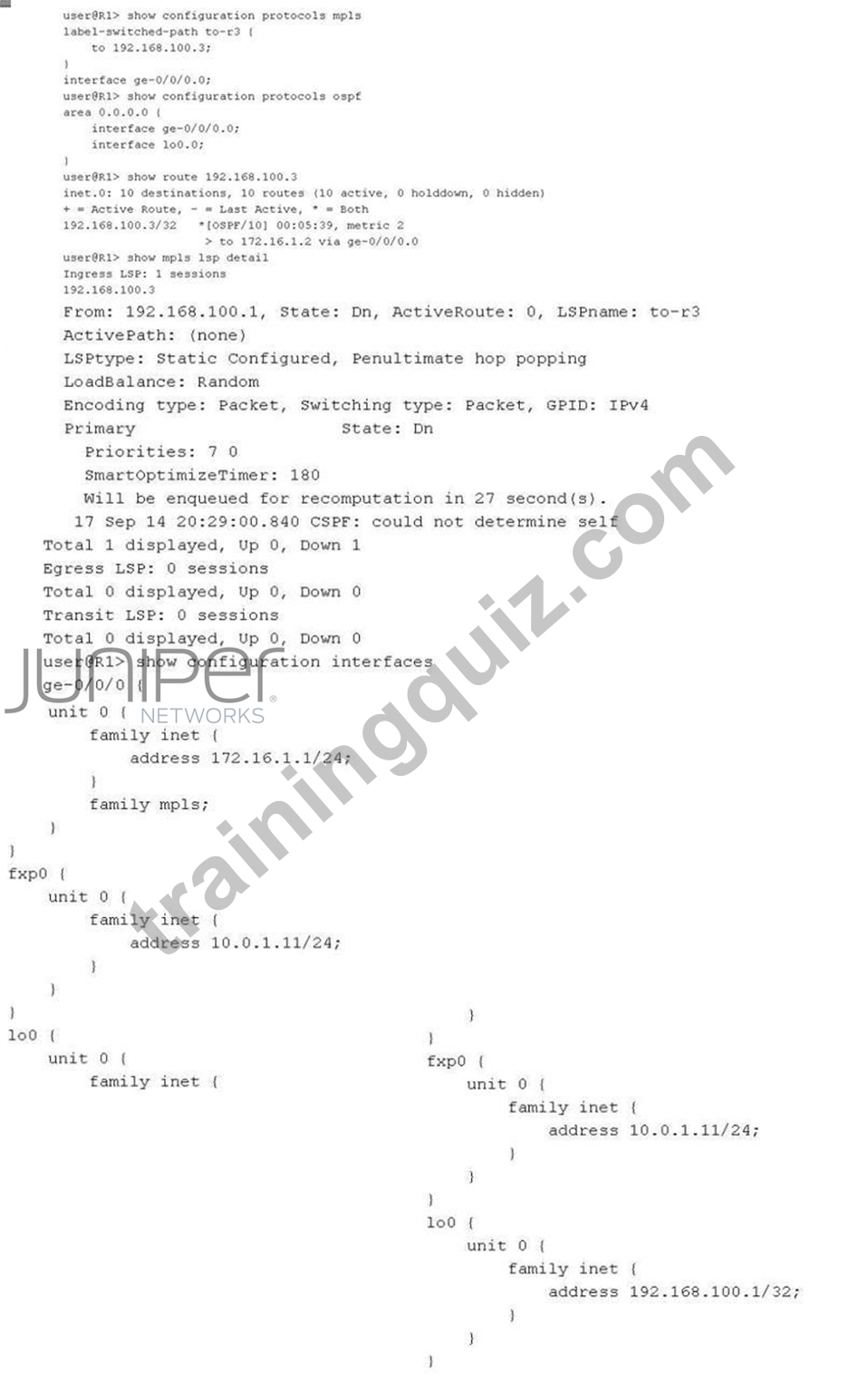
You have configured an MPLS LSP to 192.168.100.3. However, the LSP is in the down state. Referring to the exhibit, which two actions would solve this problem? (Choose two.)
- A. Issue the set protocols ospf traffic-engineering command and commit.
- B. Issue the set interfaces lo0 family mpls command on router R1 and commit.
- C. Issue the set protocols mpls label-switched-path to-r3 no-cspf command and commit.
- D. Issue the set routing-options rib inet.3 static route 192.168.100.1 command and commit.
Answer: A,C
Explanation:
In a Juniper Networks environment, establishing a functionalMultiprotocol Label Switching (MPLS)Label- Switched Path (LSP) requires synchronized control plane operations. According to Juniper technical documentation, the most common reason for an LSP to remain in the "Down" state at the ingress router is a failure of theConstrained Shortest Path First (CSPF)algorithm during the path computation phase.
The provided exhibit for routerR1reveals a critical error in the show mpls lsp detail output: "CSPF: could not determine self". This specific error indicates that the CSPF process is unable to find its own local router ID within theTraffic Engineering Database (TED). For CSPF to build a valid TED, the underlying Interior Gateway Protocol (IGP), such as OSPF, must be configured to flood opaque link-state advertisements (Type
10 LSAs) that carry traffic engineering attributes. As seen in the OSPF configuration, traffic engineering is not enabled. Therefore, issuing theset protocols ospf traffic-engineeringcommand (Option D) will allow R1 to populate the TED with its own local information and that of its neighbors, enabling CSPF to calculate a valid path.
Alternatively, an administrator can choose to bypass the requirement for a TED entirely by disabling CSPF on the specific LSP. By issuing theset protocols mpls label-switched-path to-r3 no-cspfcommand (Option B), the router will stop attempting to perform a constrained path calculation. Instead, the signaling protocol (RSVP) will rely on the standardinet.0routing table to determine the hop-by-hop path to the egress destination (192.168.100.3), allowing the LSP to establish without traffic engineering constraints.
Regarding the other options, whilefamily mplsis required on all transit interfaces, the ingress loopback interface (lo0) generally does not require it for standard LSP signaling unless it's used as a transit hop.
Furthermore, adding a static route toinet.3(Option A) is used for next-hop resolution of BGP routes over LSPs but does not assist in the signaling or establishment of the LSP itself.
NEW QUESTION # 40
Which statement about RSVP-signaled LSPs is correct?
- A. CSPF is not required for LSPs using admin-groups.
- B. The paths used by LSPs are always calculated using the TED.
- C. The paths used by LSPs are always calculated using the SRGB.
- D. CSPF is used to calculate the path for a traffic-engineered LSP.
Answer: D
Explanation:
In a Juniper Networks environment,Resource Reservation Protocol (RSVP)is a signaling protocol used to establish Label-Switched Paths (LSPs). While RSVP handles the actual signaling (requesting labels and reserving bandwidth along a path), it does not inherently know which path to take. This is whereConstrained Shortest Path First (CSPF)comes into play.
CSPFis an advanced version of the Dijkstra algorithm used specifically for traffic engineering. Unlike the standard SPF used by IGPs, which only considers the shortest metric, CSPF takes into account multiple constraints such as available bandwidth, link coloring (administrative groups), and explicit hop requirements.
According to Juniper technical documentation, when an LSP is configured, the Ingress router uses CSPF to calculate a loop-free path that satisfies all these constraints before RSVP begins signaling. This is why statementBis the correct description of the operational flow.
StatementDis a common distractor. While CSPF uses theTraffic Engineering Database (TED)to perform its calculations, the path is not "calculated by the TED" itself; the TED is merely the repository of link-state information (provided by OSPF or IS-IS extensions). StatementCrefers to Segment Routing Global Block (SRGB), which is relevant to Segment Routing (SR-TE), not standard RSVP-signaled LSPs. Finally, statement Ais incorrect because admin-groups (link coloring) are actually one of the primary constraints thatrequire CSPF to determine a valid path.
NEW QUESTION # 41
Which IS-IS adjacency state indicates that hello packets have been exchanged but the adjacency is not yet fully established?
- A. up
- B. loading
- C. initializing
- D. two-way
Answer: C
Explanation:
In theIS-IS (Intermediate System to Intermediate System)protocol, the process of forming an adjacency between two neighbors follows a specific sequence of states. While OSPF uses states like "Init," "Two-Way," and "Full," IS-IS uses a slightly different nomenclature within its state machine.
According to Juniper Networks technical documentation, when a router first sends anIS-IS Hello (IIH) PDU and receives one back from a neighbor, but has not yet confirmed that the neighbor "sees" it back, the adjacency enters theInitializingstate. Specifically, on a point-to-point link, the state transitions fromDownto Initializingas soon as the first PDU is received. On a broadcast network (like Ethernet), the Initializing state indicates that the local router has received a Hello PDU from the neighbor, but the local router's own System ID is not yet listed in the neighbor's list of "seen" neighbors (the neighbor's Hello PDU does not yet contain the local router's MAC address).
The adjacency only moves to theUpstate (Option C) once bi-directional communication is confirmed- meaning both routers have seen each other's System IDs in the incoming Hello PDUs.
Why other options are incorrect:
* Loading (Option A):This is an OSPF state, not an IS-IS state. In IS-IS, database synchronization happens after the adjacency is Up.
* Two-Way (Option D):While functionally similar to the state IS-IS is achieving, "Two-Way" is the specific terminology for OSPF. In IS-IS, the intermediate step between knowing a neighbor exists and having a fully functional adjacency is strictly calledInitializing.
NEW QUESTION # 42
......
Dumps Real Juniper JN0-364 Exam Questions [Updated 2026]: https://actualtests.trainingquiz.com/JN0-364-training-materials.html
