

Get ready to pass the Databricks-Certified-Data-Engineer-Associate Exam right now using our Databricks Certification Exam Package
A fully updated 2024 Databricks-Certified-Data-Engineer-Associate Exam Dumps exam guide from training expert TrainingQuiz
GAQM Databricks-Certified-Data-Engineer-Associate is a certification exam designed to test the skills and knowledge of individuals in the field of data engineering. Databricks-Certified-Data-Engineer-Associate exam is created by GAQM, a leading global provider of certification programs for professionals in various industries. Databricks Certified Data Engineer Associate Exam certification is intended for those who work with Databricks and want to demonstrate their expertise in designing, building, and maintaining data pipelines using this technology.
NEW QUESTION # 17
A data engineer wants to create a new table containing the names of customers that live in France.
They have written the following command:
A senior data engineer mentions that it is organization policy to include a table property indicating that the new table includes personally identifiable information (PII).
Which of the following lines of code fills in the above blank to successfully complete the task?
- A. There is no way to indicate whether a table contains PII.
- B. PII
- C. "COMMENT PII"
- D. TBLPROPERTIES PII
- E. COMMENT "Contains PII"
Answer: E
Explanation:
In Databricks, when creating a table, you can add a comment to columns or the entire table to provide more information about the data it contains. In this case, since it's organization policy to indicate that the new table includes personally identifiable information (PII), option D is correct. The line of code would be added after defining the table structure and before closing with a semicolon. Reference: Data Engineer Associate Exam Guide, CREATE TABLE USING (Databricks SQL)
NEW QUESTION # 18
Which of the following code blocks will remove the rows where the value in column age is greater than 25 from the existing Delta table my_table and save the updated table?
- A. UPDATE my_table WHERE age <= 25;
- B. SELECT * FROM my_table WHERE age > 25;
- C. DELETE FROM my_table WHERE age <= 25;
- D. UPDATE my_table WHERE age > 25;
- E. DELETE FROM my_table WHERE age > 25;
Answer: E
NEW QUESTION # 19
A data engineer runs a statement every day to copy the previous day's sales into the table transactions. Each day's sales are in their own file in the location "/transactions/raw".
Today, the data engineer runs the following command to complete this task:
After running the command today, the data engineer notices that the number of records in table transactions has not changed.
Which of the following describes why the statement might not have copied any new records into the table?
- A. The names of the files to be copied were not included with the FILES keyword.
- B. The previous day's file has already been copied into the table.
- C. The format of the files to be copied were not included with the FORMAT_OPTIONS keyword.
- D. The COPY INTO statement requires the table to be refreshed to view the copied rows.
- E. The PARQUET file format does not support COPY INTO.
Answer: B
Explanation:
The COPY INTO statement is an idempotent operation, which means that it will skip any files that have already been loaded into the target table1. This ensures that the data is not duplicated or corrupted by multiple attempts to load the same file. Therefore, if the data engineer runs the same command every day without specifying the names of the files to be copied with the FILES keyword or a glob pattern with the PATTERN keyword, the statement will only copy the first file that matches the source location and ignore the rest. To avoid this problem, the data engineer should either use the FILES or PATTERN keywords to filter the files to be copied based on the date or some other criteria, or delete the files from the source location after they are copied into the table2. Reference: 1: COPY INTO | Databricks on AWS 2: Get started using COPY INTO to load data | Databricks on AWS
NEW QUESTION # 20
A data analyst has created a Delta table sales that is used by the entire data analysis team. They want help from the data engineering team to implement a series of tests to ensure the data is clean. However, the data engineering team uses Python for its tests rather than SQL.
Which of the following commands could the data engineering team use to access sales in PySpark?
- A. SELECT * FROM sales
- B. spark.delta.table("sales")
- C. spark.table("sales")
- D. There is no way to share data between PySpark and SQL.
- E. spark.sql("sales")
Answer: C
Explanation:
The data engineering team can use the spark.table method to access the Delta table sales in PySpark. This method returns a DataFrame representation of the Delta table, which can be used for further processing or testing. The spark.table method works for any table that is registered in the Hive metastore or the Spark catalog, regardless of the file format1. Alternatively, the data engineering team can also use the DeltaTable.forPath method to load the Delta table from its path2. Reference: 1: SparkSession | PySpark 3.2.0 documentation 2: Welcome to Delta Lake's Python documentation page - delta-spark 2.4.0 documentation
NEW QUESTION # 21
A data engineer is attempting to drop a Spark SQL table my_table. The data engineer wants to delete all table metadata and data.
They run the following command:
DROP TABLE IF EXISTS my_table
While the object no longer appears when they run SHOW TABLES, the data files still exist.
Which of the following describes why the data files still exist and the metadata files were deleted?
- A. The table's data was smaller than 10 GB
- B. The table did not have a location
- C. The table's data was larger than 10 GB
- D. The table was external
- E. The table was managed
Answer: D
NEW QUESTION # 22
A dataset has been defined using Delta Live Tables and includes an expectations clause:
CONSTRAINT valid_timestamp EXPECT (timestamp > '2020-01-01') ON VIOLATION FAIL UPDATE What is the expected behavior when a batch of data containing data that violates these constraints is processed?
- A. Records that violate the expectation are dropped from the target dataset and recorded as invalid in the event log.
- B. Records that violate the expectation are dropped from the target dataset and loaded into a quarantine table.
- C. Records that violate the expectation are added to the target dataset and flagged as invalid in a field added to the target dataset.
- D. Records that violate the expectation are added to the target dataset and recorded as invalid in the event log.
- E. Records that violate the expectation cause the job to fail.
Answer: E
Explanation:
The expected behavior when a batch of data containing data that violates the expectation is processed is that the job will fail. This is because the expectation clause has the ON VIOLATION FAIL UPDATE option, which means that if any record in the batch does not meet the expectation, the entire batch will be rejected and the job will fail. This option is useful for enforcing strict data quality rules and preventing invalid data from entering the target dataset.
Option A is not correct, as the ON VIOLATION FAIL UPDATE option does not drop the records that violate the expectation, but fails the entire batch. To drop the records that violate the expectation and record them as invalid in the event log, the ON VIOLATION DROP RECORD option should be used.
Option C is not correct, as the ON VIOLATION FAIL UPDATE option does not drop the records that violate the expectation, but fails the entire batch. To drop the records that violate the expectation and load them into a quarantine table, the ON VIOLATION QUARANTINE RECORD option should be used.
Option D is not correct, as the ON VIOLATION FAIL UPDATE option does not add the records that violate the expectation, but fails the entire batch. To add the records that violate the expectation and record them as invalid in the event log, the ON VIOLATION LOG RECORD option should be used.
Option E is not correct, as the ON VIOLATION FAIL UPDATE option does not add the records that violate the expectation, but fails the entire batch. To add the records that violate the expectation and flag them as invalid in a field added to the target dataset, the ON VIOLATION FLAG RECORD option should be used.
Reference:
Delta Live Tables Expectations
[Databricks Data Engineer Professional Exam Guide]
NEW QUESTION # 23
A data engineer is working with two tables. Each of these tables is displayed below in its entirety.
The data engineer runs the following query to join these tables together:
Which of the following will be returned by the above query?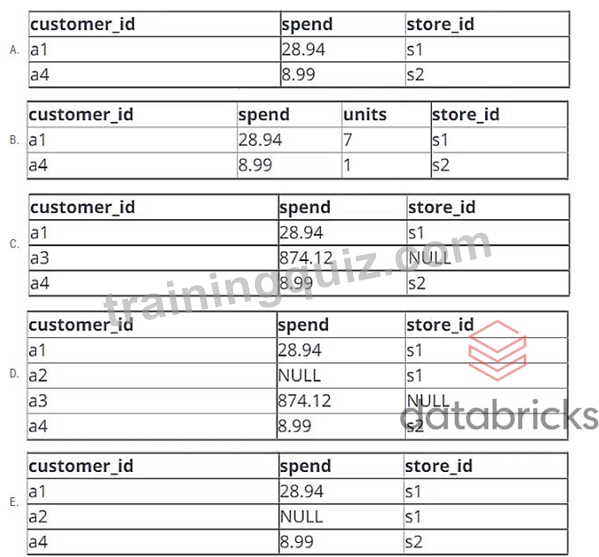
- A. Option A
- B. Option B
- C. Option E
- D. Option D
- E. Option C
Answer: A
Explanation:
Option A is the correct answer because it shows the result of an INNER JOIN between the two tables. An INNER JOIN returns only the rows that have matching values in both tables based on the join condition. In this case, the join condition is ON a.customer_id = c.customer_id, which means that only the rows that have the same customer ID in both tables will be included in the output. The output will have four columns: customer_id, name, account_id, and overdraft_amt. The output will have four rows, corresponding to the four customers who have accounts in the account table.
NEW QUESTION # 24
A data engineer has a single-task Job that runs each morning before they begin working. After identifying an upstream data issue, they need to set up another task to run a new notebook prior to the original task.
Which of the following approaches can the data engineer use to set up the new task?
- A. They can clone the existing task to a new Job and then edit it to run the new notebook.
- B. They can create a new task in the existing Job and then add it as a dependency of the original task.
- C. They can create a new task in the existing Job and then add the original task as a dependency of the new task.
- D. They can clone the existing task in the existing Job and update it to run the new notebook.
- E. They can create a new job from scratch and add both tasks to run concurrently.
Answer: B
Explanation:
To set up the new task to run a new notebook prior to the original task in a single-task Job, the data engineer can use the following approach: In the existing Job, create a new task that corresponds to the new notebook that needs to be run. Set up the new task with the appropriate configuration, specifying the notebook to be executed and any necessary parameters or dependencies. Once the new task is created, designate it as a dependency of the original task in the Job configuration. This ensures that the new task is executed before the original task.
NEW QUESTION # 25
A data engineer wants to create a data entity from a couple of tables. The data entity must be used by other data engineers in other sessions. It also must be saved to a physical location.
Which of the following data entities should the data engineer create?
- A. Table
- B. Temporary view
- C. View
- D. Database
- E. Function
Answer: A
Explanation:
A table is a data entity that is stored in a physical location and can be accessed by other data engineers in other sessions. A table can be created from one or more tables using the CREATE TABLE or CREATE TABLE AS SELECT commands. A table can also be registered from an existing DataFrame using the spark.catalog.createTable method. A table can be queried using SQL or DataFrame APIs. A table can also be updated, deleted, or appended using the MERGE INTO command or the DeltaTable API. References:
* Create a table
* Create a table from a query result
* Register a table from a DataFrame
* [Query a table]
* [Update, delete, or merge into a table]
NEW QUESTION # 26
Which of the following describes a scenario in which a data engineer will want to use a single-node cluster?
- A. When they are concerned about the ability to automatically scale with larger data
- B. When they are working with SQL within Databricks SQL
- C. When they are running automated reports to be refreshed as quickly as possible
- D. When they are manually running reports with a large amount of data
- E. When they are working interactively with a small amount of data
Answer: E
Explanation:
Explanation
A Single Node cluster is a cluster consisting of an Apache Spark driver and no Spark workers. A Single Node cluster supports Spark jobs and all Spark data sources, including Delta Lake. A Standard cluster requires a minimum of one Spark worker to run Spark jobs.
NEW QUESTION # 27
A data analyst has created a Delta table sales that is used by the entire data analysis team. They want help from the data engineering team to implement a series of tests to ensure the data is clean. However, the data engineering team uses Python for its tests rather than SQL.
Which of the following commands could the data engineering team use to access sales in PySpark?
- A. SELECT * FROM sales
- B. spark.delta.table("sales")
- C. spark.table("sales")
- D. There is no way to share data between PySpark and SQL.
- E. spark.sql("sales")
Answer: C
NEW QUESTION # 28
A data engineer runs a statement every day to copy the previous day's sales into the table transactions. Each day's sales are in their own file in the location "/transactions/raw".
Today, the data engineer runs the following command to complete this task: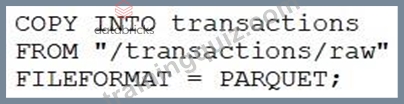
After running the command today, the data engineer notices that the number of records in table transactions has not changed.
Which of the following describes why the statement might not have copied any new records into the table?
- A. The names of the files to be copied were not included with the FILES keyword.
- B. The previous day's file has already been copied into the table.
- C. The format of the files to be copied were not included with the FORMAT_OPTIONS keyword.
- D. The COPY INTO statement requires the table to be refreshed to view the copied rows.
- E. The PARQUET file format does not support COPY INTO.
Answer: B
Explanation:
Explanation
https://docs.databricks.com/en/ingestion/copy-into/index.html The COPY INTO SQL command lets you load data from a file location into a Delta table. This is a re-triable and idempotent operation; files in the source location that have already been loaded are skipped. if there are no new records, the only consistent choice is C no new files were loaded because already loaded files were skipped.
NEW QUESTION # 29
Which of the following tools is used by Auto Loader process data incrementally?
- A. Databricks SQL
- B. Checkpointing
- C. Unity Catalog
- D. Spark Structured Streaming
- E. Data Explorer
Answer: D
Explanation:
Auto Loader provides a Structured Streaming source called cloudFiles that can process new data files as they arrive in cloud storage without any additional setup. Auto Loader uses a scalable key-value store to track ingestion progress and ensure exactly-once semantics. Auto Loader can ingest various file formats and load them into Delta Lake tables. Auto Loader is recommended for incremental data ingestion with Delta Live Tables, which extends the functionality of Structured Streaming and allows you to write declarative Python or SQL code to deploy a production-quality data pipeline. References: What is Auto Loader?, What is Auto Loader? | Databricks on AWS, Solved: How does Auto Loader ingest data? - Databricks - 5629
NEW QUESTION # 30
A data engineer needs to determine whether to use the built-in Databricks Notebooks versioning or version their project using Databricks Repos.
Which of the following is an advantage of using Databricks Repos over the Databricks Notebooks versioning?
- A. Databricks Repos provides the ability to comment on specific changes
- B. Databricks Repos allows users to revert to previous versions of a notebook
- C. Databricks Repos automatically saves development progress
- D. Databricks Repos supports the use of multiple branches
- E. Databricks Repos is wholly housed within the Databricks Lakehouse Platform
Answer: D
Explanation:
Databricks Repos is a visual Git client and API in Databricks that supports common Git operations such as cloning, committing, pushing, pulling, and branch management. Databricks Notebooks versioning is a legacy feature that allows users to link notebooks to GitHub repositories and perform basic Git operations. However, Databricks Notebooks versioning does not support the use of multiple branches for development work, which is an advantage of using Databricks Repos. With Databricks Repos, users can create and manage branches for different features, experiments, or bug fixes, and merge, rebase, or resolve conflicts between them. Databricks recommends using a separate branch for each notebook and following data science and engineering code development best practices using Git for version control, collaboration, and CI/CD. Reference: Git integration with Databricks Repos - Azure Databricks | Microsoft Learn, Git version control for notebooks (legacy) | Databricks on AWS, Databricks Repos Is Now Generally Available - New 'Files' Feature in ..., Databricks Repos - What it is and how we can use it | Adatis.
NEW QUESTION # 31
A data analyst has developed a query that runs against Delta table. They want help from the data engineering team to implement a series of tests to ensure the data returned by the query is clean. However, the data engineering team uses Python for its tests rather than SQL.
Which of the following operations could the data engineering team use to run the query and operate with the results in PySpark?
- A. SELECT * FROM sales
- B. spark.sql
- C. spark.table
- D. There is no way to share data between PySpark and SQL.
- E. spark.delta.table
Answer: B
Explanation:
The spark.sql operation allows the data engineering team to run a SQL query and return the result as a PySpark DataFrame. This way, the data engineering team can use the same query that the data analyst has developed and operate with the results in PySpark. For example, the data engineering team can use spark.sql("SELECT * FROM sales") to get a DataFrame of all the records from the sales Delta table, and then apply various tests or transformations using PySpark APIs. The other options are either not valid operations (A, D), not suitable for running a SQL query (B, E), or not returning a DataFrame (A). Reference: Databricks Documentation - Run SQL queries, Databricks Documentation - Spark SQL and DataFrames.
NEW QUESTION # 32
A data engineer has configured a Structured Streaming job to read from a table, manipulate the data, and then perform a streaming write into a new table.
The cade block used by the data engineer is below: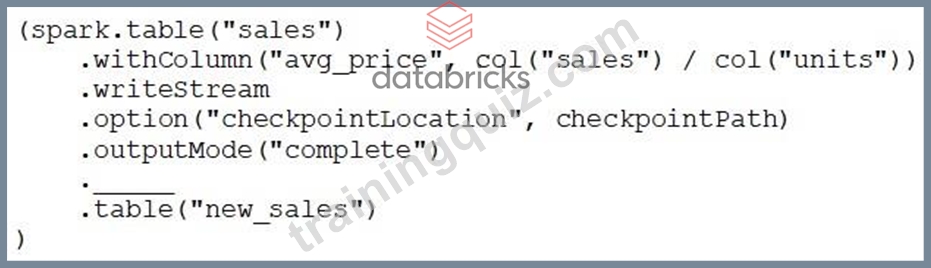
If the data engineer only wants the query to execute a micro-batch to process data every 5 seconds, which of the following lines of code should the data engineer use to fill in the blank?
- A. trigger(processingTime="5 seconds")
- B. trigger(once="5 seconds")
- C. trigger(continuous="5 seconds")
- D. trigger()
- E. trigger("5 seconds")
Answer: A
Explanation:
Explanation
# ProcessingTime trigger with two-seconds micro-batch interval
df.writeStream \
format("console") \
trigger(processingTime='2 seconds') \
start()
https://spark.apache.org/docs/latest/structured-streaming-programming-guide.html#triggers
NEW QUESTION # 33
Which of the following benefits of using the Databricks Lakehouse Platform is provided by Delta Lake?
- A. The ability to collaborate in real time on a single notebook
- B. The ability to distribute complex data operations
- C. The ability to set up alerts for query failures
- D. The ability to manipulate the same data using a variety of languages
- E. The ability to support batch and streaming workloads
Answer: E
NEW QUESTION # 34
In order for Structured Streaming to reliably track the exact progress of the processing so that it can handle any kind of failure by restarting and/or reprocessing, which of the following two approaches is used by Spark to record the offset range of the data being processed in each trigger?
- A. Checkpointing and Idempotent Sinks
- B. Replayable Sources and Idempotent Sinks
- C. Checkpointing and Write-ahead Logs
- D. Structured Streaming cannot record the offset range of the data being processed in each trigger.
- E. Write-ahead Logs and Idempotent Sinks
Answer: A
NEW QUESTION # 35
A data engineer needs to determine whether to use the built-in Databricks Notebooks versioning or version their project using Databricks Repos.
Which of the following is an advantage of using Databricks Repos over the Databricks Notebooks versioning?
- A. Databricks Repos provides the ability to comment on specific changes
- B. Databricks Repos allows users to revert to previous versions of a notebook
- C. Databricks Repos automatically saves development progress
- D. Databricks Repos supports the use of multiple branches
- E. Databricks Repos is wholly housed within the Databricks Lakehouse Platform
Answer: D
Explanation:
Explanation
An advantage of using Databricks Repos over the built-in Databricks Notebooks versioning is the ability to work with multiple branches. Branching is a fundamental feature ofversion control systems like Git, which Databricks Repos is built upon. It allows you to create separate branches for different tasks, features, or experiments within your project. This separation helps in parallel development and experimentation without affecting the main branch or the work of other team members. Branching provides a more organized and collaborative development environment, making it easier to merge changes and manage different development efforts. While Databricks Notebooks versioning also allows you to track versions of notebooks, it may not provide the same level of flexibility and collaboration as branching in Databricks Repos.
NEW QUESTION # 36
......
The Databricks Certified Data Engineer Associate Exam certification exam consists of 60 multiple-choice questions that need to be answered within 90 minutes. Databricks-Certified-Data-Engineer-Associate exam is available in English and is delivered online through the GAQM testing platform. Databricks Certified Data Engineer Associate Exam certification exam is open to all individuals who are interested in data engineering and Databricks, regardless of their educational background.
Master 2024 Latest The Questions Databricks Certification and Pass Databricks-Certified-Data-Engineer-Associate Real Exam!: https://actualtests.trainingquiz.com/Databricks-Certified-Data-Engineer-Associate-training-materials.html
