

[Feb-2026] Virginia-Real-Estate-Salesperson Braindumps – Virginia-Real-Estate-Salesperson Questions to Get Better Grades
Virginia-Real-Estate-Salesperson Exam Dumps - Try Best Virginia-Real-Estate-Salesperson Exam Questions - TrainingQuiz
NEW QUESTION # 62
Which of these is an example of a deed restriction?
- A. A restriction in one subdivision development specifies that no boats or recreational vehicles may be kept on the street, driveway, or lot.
- B. The city denies Darren a permit to open a pawn shop in a residential area.
- C. Demi is required to file an environmental impact statement with the city before building a new subdivision.
- D. Donald is required by the municipal government to have a certain number of bathrooms in his business.
Answer: A
Explanation:
Deed restrictions (also called restrictive covenants) are private restrictions placed in deeds or subdivision rules by developers or homeowners associations.
They control how property can be used (e.g., no RVs, no fences over certain height).
Other options:
(A) City denying permit = zoning regulation (public restriction).
(C) Environmental impact statement = government regulation, not a deed restriction.
(D) Bathroom requirement = building code, not private restriction.
Reference:
Virginia Real Estate Principles & Practices - Land Use Controls (public vs private) Code of Virginia Title 55.1, Chapter 19 (Restrictive Covenants)
NEW QUESTION # 63
What is the perimeter of a rectangular lot with the dimensions of 40 ft. x 50 ft .?
- A. 90 ft.
- B. 200 ft.
- C. 180 ft.
- D. 150 ft.
Answer: C
Explanation: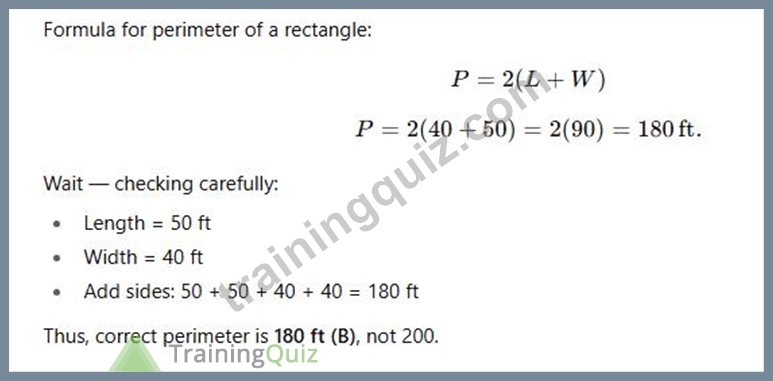
Reference (Virginia Real Estate Math):
Real Estate Math section in Virginia pre-license education
A490-02REGS.pdf - Math requirements for licensure
✅ Corrected: Answer = B. 180 ft
NEW QUESTION # 64
Which of these is likely to be the lien with the highest priority?
- A. attachment lien
- B. mortgage
- C. mechanic's lien
- D. tax lien
Answer: D
Explanation:
Real estate tax liens (property taxes and special assessments) take highest priority over all other liens, regardless of recording date.
Priority order:
Property tax liens
Special assessments
Mortgages (by recording date)
Mechanic's liens (priority may vary but generally after taxes/mortgages) Other options:
(A) Mortgage - common lien but lower than tax lien.
(C) Attachment lien - granted by court, lower priority.
(D) Mechanic's lien - priority can date back to start of work, but still after tax liens.
Reference:
Code of Virginia §58.1-3340 et seq. (Real estate tax liens)
Virginia Real Estate Principles & Practices - Liens and Priority
NEW QUESTION # 65
An opinion of title, a certificate of title, a Torrens certificate, and title insurance are all examples of:
- A. cloud on a title
- B. equitable title
- C. chain of title
- D. evidence of title
Answer: D
Explanation:
Evidence of title refers to documents or assurances showing that the seller has good title to convey.
Examples include:
Opinion of title (by attorney)
Certificate of title
Torrens certificate
Title insurance policy
These are all methods of proving ownership rights.
Other options:
(A) Cloud on title = defects/encumbrances.
(B) Equitable title = buyer's right after signing a contract but before closing.
(D) Chain of title = historical record of ownership.
Reference:
Virginia Real Estate Principles & Practices - Title Evidence
Code of Virginia §55.1 (Property and Conveyances)
NEW QUESTION # 66
Your client is buying a home. At closing, they pull you aside and whisper that the documents they're being asked to sign don't match the Closing Disclosure - suddenly, there are thousands of dollars of new fees. Is this a red flag for predatory lending? Why or why not?
- A. Yes. No client should be paying fees at closing. Those should always be pre-paid to the lender at least three days in advance.
- B. No. It's normal for lenders to have significant last-minute changes to their fees.
- C. Yes. The fees should match what was on the Closing Disclosure. Otherwise, that's a major red flag.
- D. No. As long as the title company has no objections, it doesn't matter if the Closina Disclosure and the real closina documents match.
Answer: C
Explanation:
Under the TRID Rule (TILA-RESPA Integrated Disclosure), lenders must provide borrowers with a Closing Disclosure (CD) at least 3 business days before closing.
The numbers on the CD and closing documents must match (with very limited tolerance ranges).
Significant last-minute fee increases are a red flag for predatory lending or RESPA/TILA violations.
The client should not sign until discrepancies are resolved.
Reference (Virginia Real Estate & Federal Law):
TRID (12 CFR 1026.19(f))
Virginia Real Estate Principles - Financing and Settlement section
A490-02REGS.pdf - Loan closing requirements
NEW QUESTION # 67
Which of these is a federal law that aims to protect people and the environment from the harmful effects of air pollution?
- A. Safe Drinking Water Act
- B. Superfund Amendments and Reauthorization Act
- C. Clean Air Act
- D. CERCLA
Answer: C
Explanation:
The Clean Air Act (CAA) is the federal law designed to protect human health and the environment from the harmful effects of air pollution.
It authorizes the EPA to set air quality standards, regulate emissions from industries and vehicles, and enforce compliance.
Other options:
(B) Safe Drinking Water Act → protects water quality.
(C) Superfund Amendments and Reauthorization Act (SARA) → expands CERCLA's hazardous waste cleanup responsibilities.
(D) CERCLA (Comprehensive Environmental Response, Compensation, and Liability Act) → governs cleanup of hazardous waste sites ("Superfund").
Reference (Virginia Real Estate):
Clean Air Act, 42 U.S.C. § 7401 et seq.
Virginia Real Estate Principles - Environmental issues section
NEW QUESTION # 68
A deed in lieu of foreclosure is often referred to as a "friendly foreclosure" because:
- A. This alternative to foreclosure requires the agreement and cooperation of both lender and borrower.
- B. This alternative to foreclosure is an option only available to friends or family of the lender.
- C. This alternative to foreclosure only takes place when the foreclosure sale buyer is a friend or family member.
- D. This alternative to foreclosure is handled by legal representatives known as "friends of the court."
Answer: A
Explanation:
A deed in lieu of foreclosure is when a borrower voluntarily conveys the property title back to the lender to avoid foreclosure.
It is called a "friendly foreclosure" because it requires mutual consent between borrower and lender, avoiding the formal court-ordered process.
Other options:
(A) Wrong - not limited to friends/family.
(C) Wrong - not related to "friends of the court."
(D) Wrong - buyer's relationship irrelevant.
Reference:
Virginia Real Estate Principles & Practices - Foreclosure Alternatives
NEW QUESTION # 69
When must a lender provide borrowers with a Closing Disclosure?
- A. at least three business days before the consummation of the loan
- B. on the day of closing
- C. at the end of the closing ceremony
- D. at least five business days after consummation of the loan
Answer: A
Explanation:
The TILA-RESPA Integrated Disclosure Rule (TRID) requires that the lender provide the Closing Disclosure (CD) at least three business days prior to loan consummation. This ensures that borrowers have adequate time to review the final loan terms, costs, and obligations.
If significant changes occur (such as APR change beyond tolerance, loan product change, or addition of a prepayment penalty), a new three-day waiting period is triggered.
This rule is enforced by the Consumer Financial Protection Bureau (CFPB) but is an important part of Virginia real estate education since agents must be aware of closing timelines.
Reference (Virginia Real Estate & Federal):
TRID Rule under Regulation Z (12 CFR 1026.19(f))
NEW QUESTION # 70
Per se violations are:
- A. acts that are in violation of CAN-SPAM
- B. acts that are in violation of the TCPA
- C. acts that are NOT considered inherentty illegal
- D. acts that are considered inherently illegal
Answer: D
Explanation:
In antitrust law, a per se violation is an act that is considered inherently illegal, regardless of intent or outcome.
Examples in real estate:
Price-fixing (brokers agreeing on commission rates).
Market allocation (dividing territories or clients).
Group boycotts (agreeing not to deal with a competitor).
These acts automatically violate the Sherman Antitrust Act without requiring proof of harm.
Other options confuse per se violations with other laws like TCPA (Do Not Call) or CAN-SPAM (email).
Reference (Virginia Real Estate):
Sherman Antitrust Act, 15 U.S.C. §§ 1-7
Virginia Real Estate Principles - Antitrust section
A490-02REGS.pdf - Professional conduct and antitrust
NEW QUESTION # 71
Which of the following is a unique quality of limited service agents in Virginia?
- A. Limited service agents can assist in commercial transactions ONLY.
- B. Limited service agents can assist in both residential and commercial transactions.
- C. Limited service agents can assist in neither residential nor commercial transactions.
- D. Limited service agents can assist in residential transactions ONLY.
Answer: B
Explanation:
In Virginia, a limited service agent is a licensee who enters into a brokerage agreement that provides fewer services than a standard brokerage agreement.
The law requires that the agent's limited duties must be disclosed in writing.
These agents can operate in both residential and commercial transactions, not just one type.
Other options:
(A) Wrong - They can assist in both.
(B) Wrong - Not limited to residential.
(C) Wrong - Not limited to commercial.
Reference:
Code of Virginia §54.1-2138.1 (Limited service agent defined)
Real Estate Board Regulations, 18 VAC 135-20-300
NEW QUESTION # 72
A partially amortizing loan will include:
- A. equal monthly payments that contribute to both principal and interest until the
- B. a balloon payment
- C. non-refinancing clauses
- D. multiple lenders
Answer: B
Explanation:
entire loan is paid
Explanation:
A partially amortizing loan requires regular monthly payments covering interest and some principal, but the loan is not fully paid off at the end of the term.
At maturity, a balloon payment (lump sum of the remaining balance) is due.
Other options:
(B) Non-refinancing clause - not a defining feature.
(C) Multiple lenders - irrelevant.
(D) Equal monthly payments until fully paid - that describes a fully amortizing loan, not partial.
Reference:
Virginia Real Estate Finance Principles - Loan types
National exam content outline (Amortization & balloon loans)
NEW QUESTION # 73
Which of these types of loans can always be sold on the secondary mortgage market?
- A. non-conforming loans
- B. conforming loans
- C. jumbo loans
- D. loans originated by Fannie Mae
Answer: B
Explanation:
Loans are classified as conforming or non-conforming:
Conforming loans: Meet Fannie Mae/Freddie Mac guidelines (loan limits, borrower qualifications). These loans are always eligible for sale on the secondary mortgage market.
Non-conforming loans: Do not meet guidelines (e.g., jumbo loans, subprime loans). These may be sold, but not always.
Other options:
(B) Fannie Mae doesn't originate loans; it buys loans.
(C) Non-conforming loans are not always saleable.
(D) Jumbo loans exceed conforming loan limits, so they don't qualify.
Reference (Virginia Real Estate):
Fannie Mae & Freddie Mac loan guidelines
Virginia Real Estate Principles - Financing section
A490-02REGS.pdf - Secondary mortgage market
NEW QUESTION # 74
Lillian is buying a home for $355,000. She is going to put down $75,000 as her down payment on her conventional loan. Will Lillian be required to pay private mortgage insurance?
- A. No, her down payment is large enough to avoid PMI.
- B. No, but it depends solely on her credit score.
- C. Yes, her down payment does not meet the requirements to eliminate PMI.
- D. Yes, PMI is required until she reaches 50% equity.
Answer: A
Explanation:
Private Mortgage Insurance (PMI) is generally required when a borrower puts down less than 20% on a conventional loan.
Lillian's home price = $355,000
Down payment = $75,000
Loan amount = $280,000
Down payment % = $75,000 ÷ $355,000 ≈ 21.1%
Since Lillian's down payment exceeds 20%, PMI is not required.
Other options:
(A) Wrong - PMI is based on equity, not just credit score.
(B) Wrong - PMI never requires 50% equity.
(C) Wrong - She meets the equity threshold.
Reference:
Fannie Mae/Freddie Mac Conventional Loan Guidelines
Virginia Real Estate Exam Outline - Financing Section
NEW QUESTION # 75
The purpose of discount points is:
- A. to lock in an interest rate for a specified time prior to closing
- B. to lower the amount due at closing
- C. to lower the interest rate over the life of the loan
- D. to lower the property value for purposes of tax savings
Answer: C
Explanation:
Discount points are prepaid interest paid at closing to the lender.
One point = 1% of the loan amount.
By paying points upfront, borrowers receive a lower interest rate over the life of the loan (commonly referred to as "buying down the rate").
Other options:
(B) Wrong - has nothing to do with property taxes.
(C) Wrong - that describes an interest rate lock, not discount points.
(D) Wrong - points increase closing costs.
Reference:
Virginia Real Estate Finance Principles - Discount Points
Fannie Mae Guidelines - Loan Costs
NEW QUESTION # 76
Which of the following contracts has no legal effect and typically involves an illegal act, fraud, misrepresentation,duress, or undue influence?
- A. an implied contract
- B. a valid contract
- C. a void contract
- D. an oral contract
Answer: C
Explanation:
A void contract is one that has no legal effect from the beginning. It is not enforceable by law because it lacks essential legal elements or involves unlawful acts. Common reasons:
Illegal act (e.g., contract to sell illegal drugs)
Fraud, misrepresentation, duress, undue influence
Lacks capacity or lawful purpose
Other options:
(B) Valid contract = fully enforceable by law.
(C) Implied contract = created by actions, not words, but still enforceable.
(D) Oral contract = valid (except when required in writing by the Statute of Frauds).
Reference (Virginia Real Estate):
Virginia Code § 11-2 (Statute of Frauds)
Virginia Real Estate Principles - Contract Law section
A490-02REGS.pdf - Contracts & Legal Enforceability
NEW QUESTION # 77
In Virginia, a supervising broker is:
- A. a broker who is NOT affiliated with the brokerage representing a principal in a real estate transaction
- B. a broker who opts to work under another broker and has no agents assigned to them
- C. a broker who has been designated by a principal broker to oversee the provision of real estate brokerage services by associate brokers and salespersons assigned to a branch office or a real estate team
- D. the licensed broker of a firm who takes responsibility for the actions of the firm and licensees; there is only one in the firm
Answer: C
Explanation:
In Virginia, the principal broker is the broker of record, legally responsible for the entire firm.
A supervising broker is one who is designated by the principal broker to manage day-to-day activities of salespersons or associate brokers in:
A branch office, OR
A specific real estate team.
Other options:
(B) = principal broker definition, not supervising broker.
(C) = outside broker, not correct.
(D) = describes an associate broker.
Reference:
Code of Virginia §54.1-2100 (Definitions of principal broker, supervising broker) Real Estate Board Regulations 18 VAC 135-20-50 (Broker supervision requirements)
NEW QUESTION # 78
In Virginia, how many years do records need to be kept for?
- A. three years
- B. five years
- C. two years
- D. one year
Answer: A
Explanation:
Virginia requires brokers and firms to retain all financial, transactional, and escrow records for three years.
This includes contracts, disclosures, closing statements, and escrow records.
The three-year period usually begins from the date of closing or termination of the transaction.
Reference:
Virginia Code §54.1-2108 (Broker records retention requirements)
NEW QUESTION # 79
What is a management proposal?
- A. a report prepared by the property manager that informs the property owner(s) of their property's expenses, income, and disbursements
- B. a plan a property manager creates for managing a property, including an analysis of the market, financial standing, and operating budget
- C. a budget for variable expenses
- D. a subdivision plan that includes residential dwellings along with nonresidential real estate
Answer: B
Explanation:
A management proposal is created by a property manager for the property owner. It typically includes:
Market analysis.
Property's financial condition.
Operating budget and forecast.
Management strategy for maintaining and improving the property.
Other options:
(B) A budget for variable expenses = too narrow.
(C) A financial report to owner = management report, not proposal.
(D) A subdivision plan = unrelated.
Reference (Virginia Real Estate):
Virginia Real Estate Principles - Property management section
A490-02REGS.pdf - Property management curriculum
NEW QUESTION # 80
......
Verified Virginia-Real-Estate-Salesperson exam dumps Q&As with Correct 125 Questions and Answers: https://actualtests.trainingquiz.com/Virginia-Real-Estate-Salesperson-training-materials.html
